


Cree Stud Management and Operations
Cree consists of 1,000 head of cattle, with 400 stud females grazing across “Kiah,” “Blue Haven,” and “Westrock,” located 27km south of Thangool and 70km north of Monto. Additionally, we manage properties north of Biloela, including irrigated land with alluvial black soil leucaena and grass pastures at “The Meadows” and “4 Winds.
Cree takes immense pride in our management processes, as evidenced by our 5-star rating for performance recording with BREEDPLAN. With over 20 years of objective recording, all data is recorded via live entry at the cattle yards using Stockbook software. This system ensures accuracy and efficiency, eliminating errors caused by double handling—crucial when collecting TSU samples for DNA and genomics applications.

The stud is managed with a commercially oriented focus, breeding functional, sound cattle capable of rearing high-quality calves with good weaner weights, re-breeding each year, and performing consistently across varying seasons and environmental conditions.
Our herd follows a closed, seasonal joining program, which is not extended during drought conditions. We join our aged breeders for 90 days, while yearling heifers (12 months of age) are joined for 60 days, with no restrictions on weight. Our primary goal is to identify early pubertal females, and as such, we do not discriminate based on weight. Yearling calves are weighed at birth to accurately track early gestation and birth weight EBV traits.
The key traits we measure are aligned to strengthen our core breeding females, contributing to the overall progression of herds within the broader industry. These traits include:
- Gestation Length
- Birth Weight
- Growth
- Puberty
- Fertility
- Carcass Quality
- Docility
All male calves undergo DNA testing with 50K SNP, are sire verified, and tested for poll gene status, Pompies, Pesti virus (negative), and myostatin.
Both male and female calves are weaned simultaneously. The male calves are grazed on grass and leucaena. The leucaena environment in which the bulls are raised prepares them for the harsher conditions they will encounter after sale, including brigalow and mulga-type country. The leucaena’s tough, stick-based terrain tests the animals’ soundness in areas such as eyes, sheaths, testicles, and feet.
At Cree, we offer paddock-prepared bulls year-round and hold an on-property auction at “Kiah” Thangool, Queensland (4716) in early September. The sale bulls are raised in leucaena paddocks supplemented with a fibre-rich ration. We grow our own hay, including wheat, oats, barley, and millet, with a composition of up to 30% grain, which is fed daily. We also provide probiotics and all essential trace elements for optimal rumen health.
This approach provides two key benefits:
Bulls must still forage in their paddocks, and the high roughage, low-grain diet supports healthy rumen bacteria, which efficiently convert grass into energy. This helps prevent any post-sale letdown period and ensures long-term physical and reproductive soundness.
It allows us to control growth rates, presenting bulls in what we believe to be optimal working condition, achieving around 1kg per day in live weight gain.
At Cree, our mission is to produce future sires for both stud and commercial operations that simultaneously offer genetic improvement across a range of profit-driving traits.

Current Sires
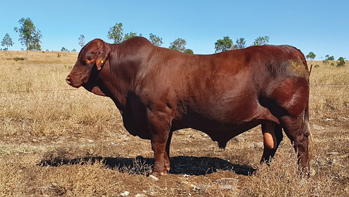
Normandy is also a polled son of King from a female that raised 7 calves. He is more of an efficient type in frame but maintains thickness and muscle with an excellent sheath, large stones and quiet temperament.
He is a trait leader for 400-Day Weight and Scrotal size and offers potential for dynamic change in female fertility without compromising growth and carcass.
To date 23 of his sons have sold to average $13,000 topping at $22,000 twice, for Normandy R108 (P) and Normandy R276 (P), selling to the Strathmore Stud, Blackall, and Mark Wilson, Banana Station respectively.

CREE NEMESIS N240 (P)
The gentle giant Nemesis, is another polled son of King and this time from a Ferrero cow. As you would expect from combining 2 of the breeds leading performance sires his predictions are powerful. A trait leader for 200, 400 and 600-Day Growth, Scrotal Size, Carcase Weight and Retail Beef Yield.
Again, a sire capable of pushing Growth and Fertility simultaneously. 11 of Nemesis’s sons have sold via auction, to average $12,900 with a top of $28,000 for Nemesis R050 (P) who sold to the Gyranda Stud.
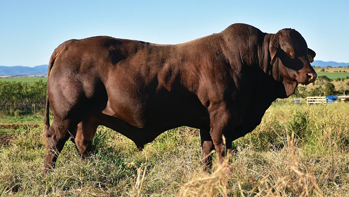
CREE NORTHERLY N116 (P)
Northerly is a polled son of King out of an aged cow that had 9 calves. Selected primarily for his outstanding phenotype and temperament, he established himself as a prominent sire with his first drop of calves.
He is a long bodied, deep, and heavy bull that weighed in at 1200kg before joining last year. With an ideal sheath, large testicles, and breed leading growth and carcass data he is a highly regarded sire in our herd. He is a trait leader for 200,400 and 600 Day-Growth, Scrotal Size, Carcase Weight and Retail Beef Yield. He has an almost identical performance graph to Nemesis but has much lower $Indexes, which we believe is due to his extreme milk ebv. Personally, we feel a bull that has the ability to combine these antagonistic traits and increase Milk, Growth and Carcase whilst maintaining Fertility, should be extolled rather than penalised.
To date 30 sons have sold at auction to average $15,500 and top at $40,000 for Northerly R222 (PP), selling to Pat and Stuart Leahy, Monto, and $32500 for Northerly S104(PP) that sold to Geoff & Meg Becker, Moura.
Past Sires

Benelkay Hercules H030(P)
Hercules was purchased for the second top price at the Benelkay Sale in 2014. We were attracted to his dark slick coat and sire appeal combined with balanced performance and polledness. A bonus has been the ability to produce small calves. We have used and recommended Hercules bulls as suitable for yearling joining’s with a high degree of success over the last few years. His calves are above average growth by weaning and combine with high carcass and fertility performance as depicted by his graph.

Cree Ferrero F140(ET)(AI)(P)
Ferrero F140 (ET) (AI) (P) was retained out of an IVF program. He is by Diamond S Top Gun 244 (P) (USA) which provides out cross genetics to Australian bloodlines. He was used in our heifers and 2 x cows for the first few seasons until his calves began to shine through. This, along with his perfect sheath, early reproductive traits, performance, and temperament saw him elevated to stud duties. Ferrero is currently a trait leader for Days to calving and RBY. His IMF is a feature, and he ranks 10th on the list of sires in the breed for Exp $Index. “Ferrero combines the contradictory traits of high milk, high growth and high female fertility in one genetic package. Common thought is that cows cannot be heavy and super fertile, or they cannot be heavy milkers and be super fertile. When bulls such as Ferrero come along, they give us a tool to make genetic change quickly over a range of traits at once.” David Greenup. Rosevale Santa Gertrudis Like King 2021 was Ferrero’s last natural progeny to be sold. He has sired over 240 calves and produced 65 performing daughters and left us a son in Monte Carlo and was also the sire of the Dams of Mexico, Moritz, Morocco, Nemesis and Papalli.
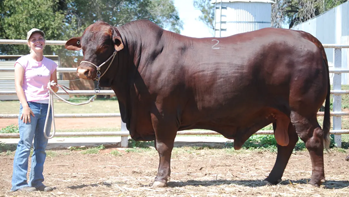
Canowindra Jag J26 (P)
Canowindra Jag was the 2012 World Congress Grand Champion Santa Gertrudis bull. We purchased him for the Australian top price of $56000 in 2012. At 32mths he was 1200kg with 150cm eye muscle area and 41cm scrotal circumference. Immediately he was collected at Rocky Repro where he produced 856 straws from two collections at 81% Morphology. In his first two seasons he sired 151 calves before sustaining a partial tear to the cruciate ligament in his stifle, sadly resulting in his inability to serve. His calves appeared to be so small we began to record birth weights for confirmation. Over approximately 20 calves ranged from 27 to 40kg for an average of 34kg. This is slightly less than what is considered to be the breed average for birth weight. However due to the high correlation between birth weight and 200 day weight Breedplan has assumed his calves would be bigger. This is not the case. However, rapid growth from birth to weaning has resulted in his high 200 day EBV.